

Documentation
What a lot number tells you about a vial
Aug
The lot number printed on a vial label is short, but it is the most important piece of information on it. It is the link between one physical vial and the full record of how that material was made, tested and released.
What a lot number is
A lot (or batch) is a quantity of material produced in a single run under the same conditions. Every vial filled from that run carries the same lot number. Because they share one production history, a test result for the lot applies to every vial in it.
What it connects to
- The Certificate of Analysis. Purity, identity and other test results for that specific lot.
- The production record. When the material was synthesised, purified and lyophilized.
- Dates. Manufacture date and, where given, a retest or expiry date.
- Shipping records. Which orders received vials from that lot.
Why it matters for your data
Reproducibility depends on knowing exactly what went into an experiment. Recording the lot number alongside your results means you can:
- Pull the matching COA at any time to confirm purity and identity
- Compare results between experiments that used the same lot or different lots
- Investigate an unexpected result by checking whether the material changed
Without a lot number, a result is tied to “a vial of BPC-157”. With one, it is tied to a documented, tested batch.
How to read a typical label
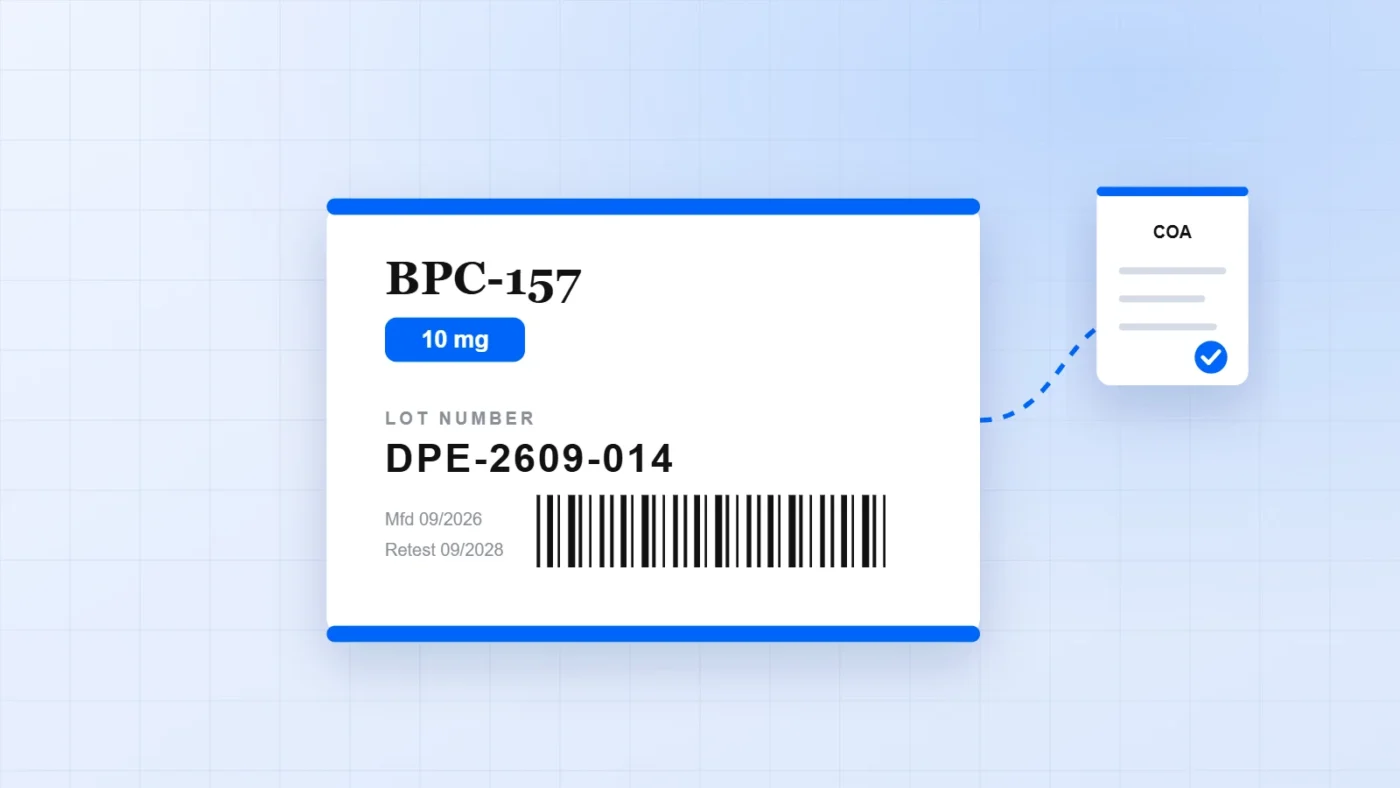
- Compound and strength, for example BPC-157 10 mg
- Lot number, for example DPE-2609-014
- Manufacture and retest dates
- A research use statement confirming the material is not for human or veterinary use
Every DNApeptidesElite vial carries a lot number, and you can use it to look up the matching COA on our site.
All DNApeptidesElite products are supplied for in vitro laboratory research only. They are not drugs, foods, cosmetics or medical devices, and are not for human or veterinary use. This article is educational and is not medical advice or dosing guidance.
