

Documentation
How to read a Certificate of Analysis, line by line
Sep
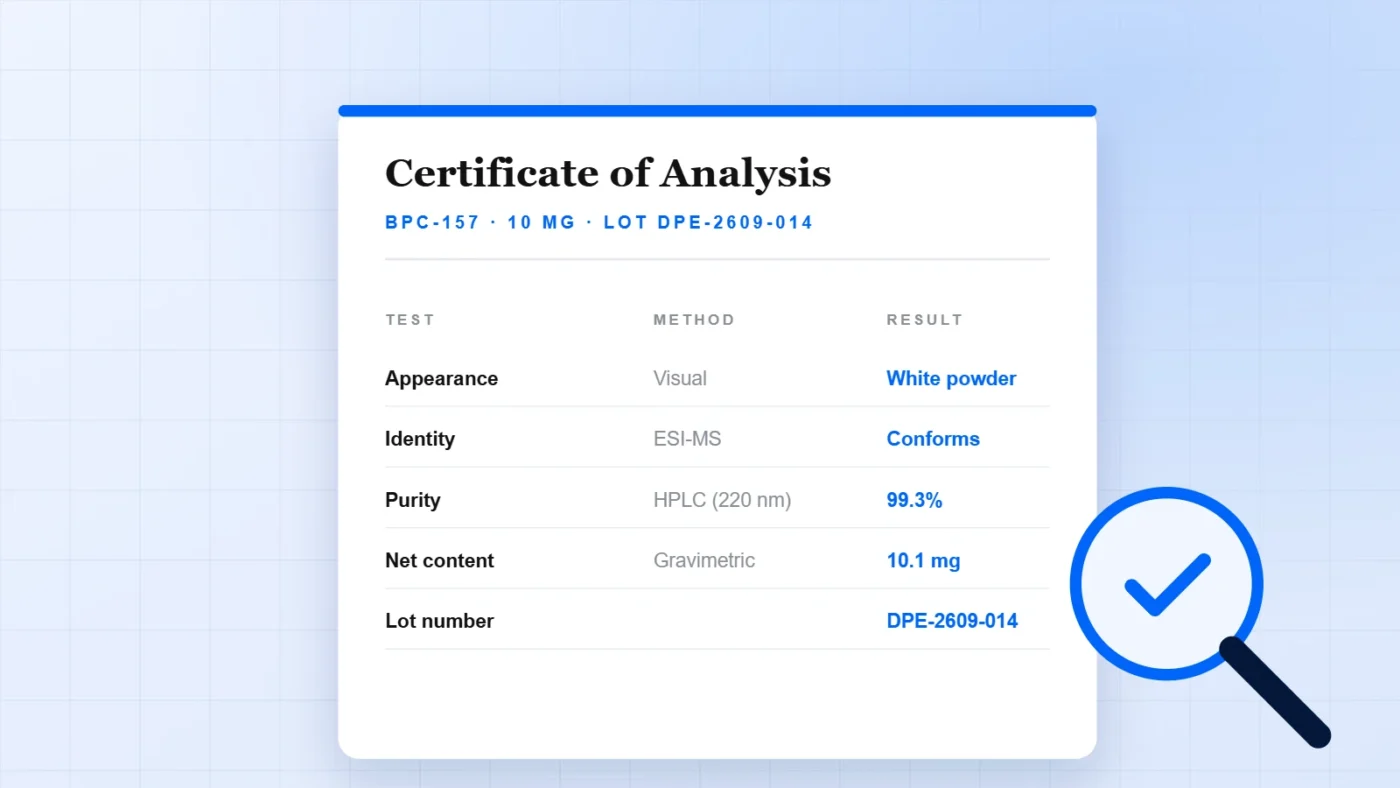
A Certificate of Analysis (COA) is the single most useful document attached to any lot of research material. It is the laboratory’s record of what was tested, how it was tested and what the result was. Reading one properly takes a few minutes, and it tells you far more than a purity number on a product page ever can.
Here is how to work through a COA from top to bottom.
1. The header: compound, strength and lot number
The top of the certificate should name the compound, the fill amount (for example 10 mg) and, most importantly, the lot or batch number. That number is what ties the paper to the physical vial in your hands. If the lot number on the COA does not match the number printed on your vial label, the certificate does not describe your material, however good the results look.
You should also see the name of the testing laboratory, the date of analysis and a unique report number. A report number lets you, or the lab, trace that exact document later.
2. Appearance
Most lyophilized peptides are reported as a white to off-white powder or cake. It sounds basic, but appearance is a quick first check: discoloration or a collapsed, sticky cake can point to moisture exposure or degradation before any instrument is used.
3. Identity
Identity answers one question: is this the molecule it claims to be? It is usually confirmed by mass spectrometry (MS), which measures the molecular mass and compares it with the theoretical value. A good COA states the method (for example ESI-MS), the expected mass, the observed mass and a clear “conforms” result.
4. Purity
Purity is normally measured by high performance liquid chromatography (HPLC). Look for three details alongside the percentage:
- Method and detection wavelength, often UV at 214 or 220 nm.
- Column type, such as a C18 reverse-phase column.
- The chromatogram itself, showing one dominant peak with small or no impurity peaks around it.
A purity figure with no method, no wavelength and no chromatogram is a claim, not a result.
5. Net content and other tests
Some certificates also report net peptide content, water content or residual solvents. These help explain the difference between the labelled fill weight and the amount of active peptide, and they are a sign of a more thorough testing program.
6. Sign-off
Finally, check for an analyst or reviewer signature and the lab’s contact details. Independent, third-party testing carries more weight than a supplier testing its own material.
A quick COA checklist
- Lot number on the COA matches the vial label
- Testing lab, report number and analysis date are present
- Identity by mass spec, with expected and observed mass
- Purity by HPLC, with method, wavelength and chromatogram
- Signed or approved by the laboratory
Every DNApeptidesElite lot ships with a lot-matched COA, and you can look up any certificate by batch number before or after you order.
All DNApeptidesElite products are supplied for in vitro laboratory research only. They are not drugs, foods, cosmetics or medical devices, and are not for human or veterinary use. This article is educational and is not medical advice or dosing guidance.
